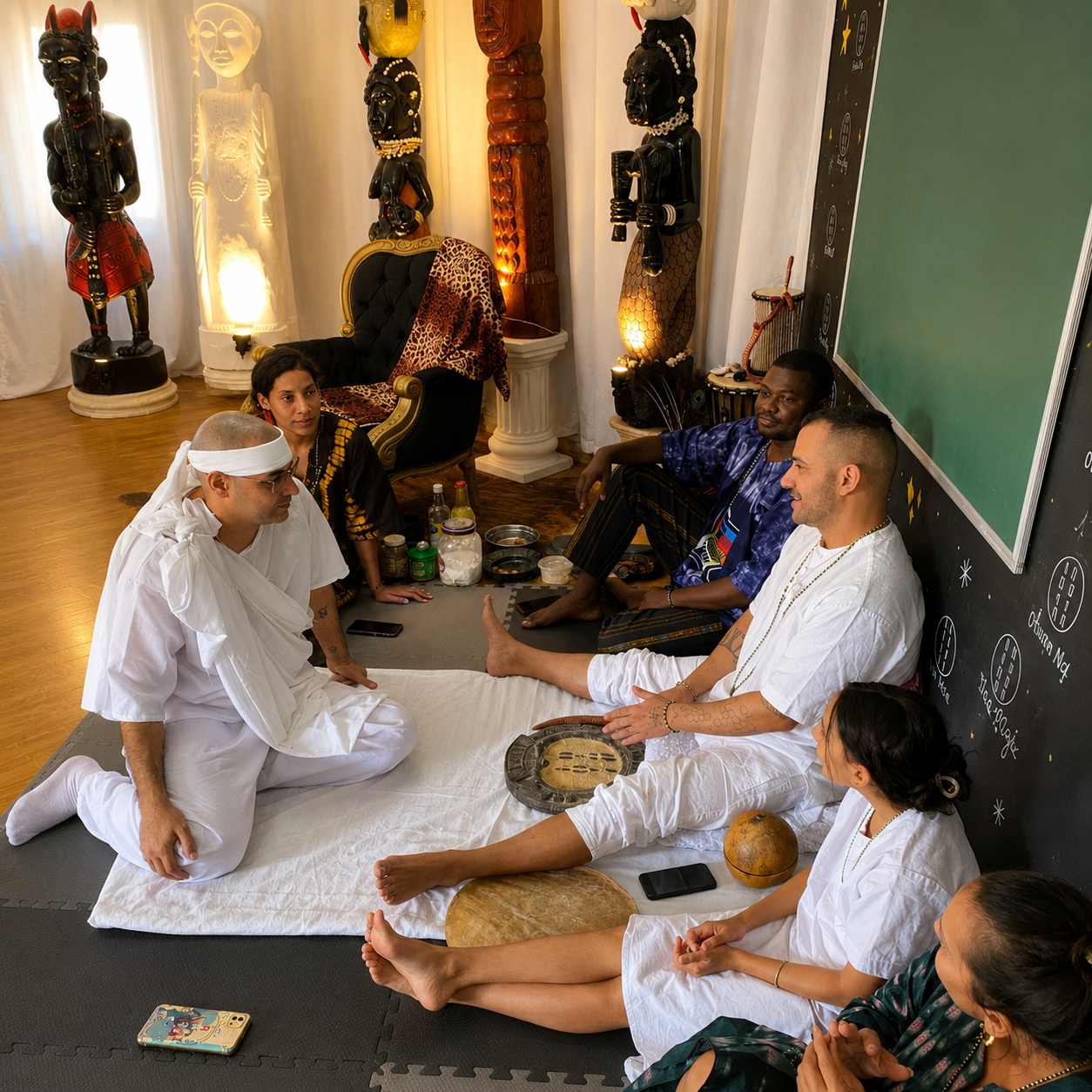
A few years ago, I shared an idea among some of my fellow Babaláwo in Yorùbáland, Nigeria, regarding the possibility of conducting collective Ifá consultations that address the realities of specific regions of the world. My reasoning was simple: while annual and global readings have their place, the experiences of people living in different parts of the world are not always the same. The social, political, economic, environmental, and spiritual conditions affecting a community in North America may be very different from those affecting communities in Africa, Europe, South America, Asia, or the Caribbean. Ifá has always been practical. It has always spoken to the realities facing people in their immediate environment. The wisdom of Ifá is universal, but its application is often local. A farmer, a trader, a king, a hunter, and a fisherman may all consult the same Ifá, yet the guidance given to each will differ according to their circumstances.
For this reason, I believe there is room for what may be called Continental Ifá Readings. Such readings should not be viewed as a challenge to existing annual world readings, lineages, temples, traditions, or authorities. They are not competitions, replacements, or attempts to establish superiority. Rather, they are opportunities for communities sharing similar realities to seek collective guidance, collective solutions, and collective spiritual alignment. The concerns facing practitioners in North America are shaped by the history, laws, economy, and culture of North America. Likewise, the concerns facing practitioners in Africa, Europe, Asia, South America, and the Caribbean are influenced by circumstances unique to those regions. It is therefore reasonable that communities seek guidance relevant to their specific conditions while remaining connected to the larger global body of Ifá practitioners.
Beyond divination itself lies the importance of collective Ẹbọ. Throughout history, communities have gathered to perform sacrifices, prayers, rituals, and acts of spiritual alignment for the protection, prosperity, stability, and well-being of the collective. If there are challenges affecting an entire region or continent, then there is value in exploring collective spiritual responses to those challenges. The strength of a people has never depended solely on individual effort but also on their ability to unite around a common purpose and work together for the greater good.
It is important to emphasize that Continental Ifá Readings should never replace or compete with the Annual World Ifá Reading. The Annual World Ifá Reading should always remain tied to the Yorùbá New Year and continue to be conducted in Yorùbáland every June, as tradition dictates. This gathering serves as the spiritual center point for practitioners around the world and should continue to be recognized as the primary collective consultation for humanity. Regardless of where practitioners reside, all continents should continue to participate in, support, and, where possible, attend the World Ifá Festivals in Yorùbáland. Our ancestral homeland remains the source from which these traditions emerged, and maintaining that connection is essential for preserving the integrity, continuity, and global unity of Ifá and Òrìṣà spirituality.
The proposed Continental Ifá Readings would therefore serve a different purpose and should be conducted at different dates and months throughout the year. Their role would be to address the specific realities, challenges, opportunities, and circumstances unique to each continent while remaining aligned with the broader wisdom revealed during the World Ifá Reading. In this way, the World Ifá Reading provides universal guidance for humanity, while continental readings provide localized applications of that guidance. This creates a balanced structure where unity is preserved through the annual gathering in Yorùbáland, while practical solutions are developed for the unique conditions experienced by practitioners in different parts of the world.
However, I believe such an initiative should only be considered where there are sufficient numbers of well-trained and experienced Babaláwo, Ìyánífá, Olórìṣà, and other knowledgeable custodians of the tradition capable of carrying out the work collectively and responsibly. If such a foundation does not yet exist within a particular continent, then there may be no need to rush into creating a continental reading. The focus should first be on developing competent practitioners, strengthening institutions, preserving knowledge, and building unity within the community. Strong foundations must always come before expansion.
My hope is that this idea continues to grow and evolve. Let Africa seek guidance for Africa. Let North America seek guidance for North America. Let South America seek guidance for South America. Let Europe, Asia, the Caribbean, and other regions do the same where the necessary foundation exists. In doing so, we are not creating division; we are acknowledging that different environments present different challenges and that wisdom requires us to address those realities directly. The future of Ifá is not found in uniformity but in its ability to remain relevant wherever people live. Ifá has survived for generations because it adapts its guidance to the needs of the moment while remaining rooted in eternal principles. Perhaps the time has come to consider how collective continental consultations can help communities navigate the unique circumstances of the age in which we live.
Prof. Olusegun Daramola
Founder, World Builderr