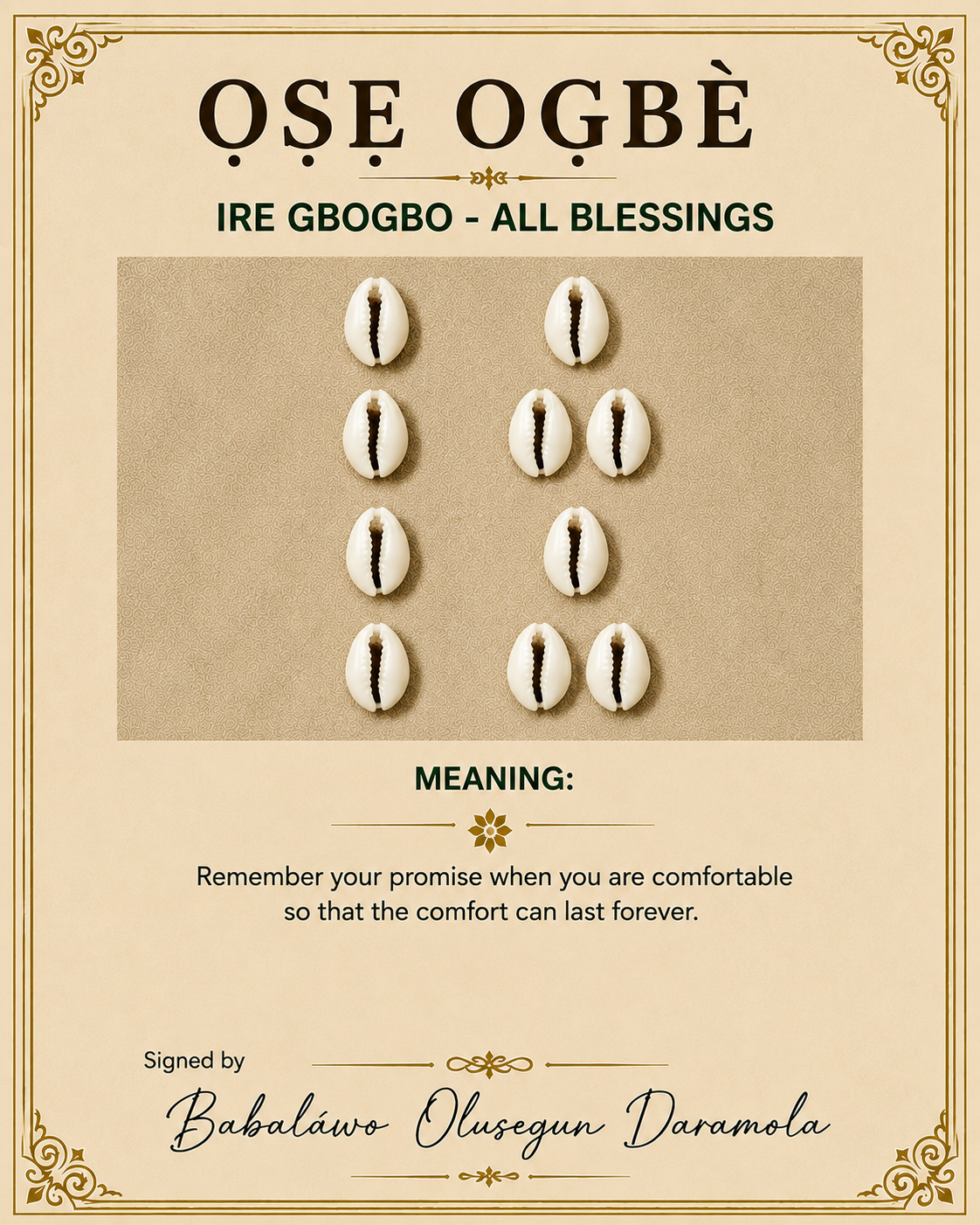
Remember Your Promise When You Become Comfortable: A Lesson from Ọ̀SẸ́ OGBÈ (Ọ̀SẸ́AFIBIṢÓLÓORE)
Inspired by a teaching shared by Àràbà Agboola Awodiran during the ÌTANIJÍ (Wake-Up Call) of Saturday, June 20, 2026, at the newly reconstructed Temple of the Indigene Faith of Africa, Ijo Orunmila Ato Inc., founded October 19, 1953.
One of the greatest tests of human character is not how we behave when life is difficult, but how we conduct ourselves after we have attained comfort, success, influence, and power. During times of hardship, many people cry to Olódùmarè, seek the guidance of Ifá, call upon the Òrìṣà, honor their ancestors, and make solemn promises concerning how they will live if their prayers are answered. Yet when blessings arrive and life becomes comfortable, those promises are often forgotten.
This timeless lesson is beautifully preserved within the sacred Odù Ifá, Ọ̀SẸ́ OGBÈ, also known as Ọ̀SẸ́AFIBIṢÓLÓORE.
The central teaching of this Odù is captured in the profound saying:
"Rántí ìlérí rẹ nígbà tí ara bá tù ọ́ kí ìdẹra náà kólè ba ọ kalẹ́."
"Remember your promise when you are comfortable so that your comfort may endure."
This wisdom is revealed through the story of Gbúke, the hunchbacked eldest son of a king.
Although Gbúke was the firstborn prince and rightful heir to the throne, he lived under the shadow of a painful reality. In traditional Yorùbá society, severe physical deformities could prevent a prince from ascending the throne. Knowing this, Gbúke carried a heavy burden of sorrow, shame, and uncertainty. He often questioned why Olódùmarè had created him differently from others and feared that his destiny would never be fulfilled.
For many years, he lived in quiet despair until he was advised to seek spiritual guidance through Ifá. He visited the respected Babaláwo, Àdáfọ̀ṣọ̀rọ̀ Lalẹ̀, who consulted Ifá on his behalf. The divination revealed the Odù Ọ̀SẸ́ OGBÈ and brought a message of hope. Ifá declared that Gbúke's condition could be transformed, but it also delivered a warning: if help came to him, he must never betray the source of that blessing.
Following the instructions of Ifá, Gbúke performed the prescribed ẹbọ and carried it personally into the forest to place beneath an Ìrókò tree. As he prepared to leave, a great python known as Erè emerged from the forest. The serpent wrapped itself around him and stretched his body until he lost consciousness.
When Gbúke eventually awoke, he reached behind his back and discovered that his hunchback had completely disappeared.
Overwhelmed with joy and gratitude, he praised Olódùmarè and thanked Ifá for the miracle. The python then spoke and asked him what promise he would make in return for the blessing he had received.
Gbúke solemnly vowed that neither he nor his descendants would ever kill or eat a snake. It would become a sacred taboo in his lineage forever.
The python accepted his promise and left him with a warning that would later define his destiny:
"Remember your promise when you become comfortable so that your comfort may last forever."
Not long afterward, Gbúke's father passed away, and the once-rejected prince was crowned king. The prophecy of Ifá had been fulfilled. The young man who once doubted his future now sat upon the throne of his ancestors.
Yet success often introduces a new test—one more dangerous than adversity.
According to custom, a newly crowned king was to be honored annually with freshly hunted game from the forest. During the first year of Gbúke's reign, the hunters searched extensively but found no animals except the python. Remembering his oath, Gbúke instructed them not to harm it.
The following year, the same thing happened. Once again, he honored his promise and spared the snake.
By the third year, however, something had changed.
The humility born from suffering had begun to fade beneath the influence of power. The authority of kingship gradually replaced the gratitude that once filled his heart. When the hunters returned and reported that the only animal available was the python, Gbúke became frustrated.
He ordered that the snake be killed.
The very creature that had restored his body, preserved his destiny, and made his kingship possible was now considered expendable.
Before the order could be carried out, the python requested to be brought before the king.
Standing in the royal court, it asked a simple question:
"Have you forgotten your promise?"
Without hesitation, Gbúke replied that the promise had expired.
At that moment, he sealed his own fate.
The hunters killed the python, and instantly the consequences manifested. Gbúke fell from his throne. His hunchback returned. His glory vanished, and he was stripped of the kingship he had worked so hard to attain.
The blessing that elevated him was withdrawn because he had forgotten the covenant that made the blessing possible.
The story of Gbúke contains a profound lesson for all humanity.
Many people remember Olódùmarè when they are struggling but forget the Source when prosperity arrives. Many remember their teachers while seeking knowledge but abandon them after gaining success. Many remember their benefactors when they need assistance but become indifferent once they attain influence and status. Others forget the sacrifices they made, the prayers they prayed, and the promises they uttered during seasons of difficulty.
Ọ̀SẸ́ OGBÈ teaches that gratitude is more than an emotion—it is a sacred obligation. Blessings are often sustained by humility, integrity, loyalty, and remembrance. The same spiritual forces that elevate a person can withdraw their support when arrogance and ingratitude take root.
The story of Gbúke is not merely a tale about a king and a snake. It is a mirror reflecting the human condition. It reminds us that success should deepen our gratitude rather than diminish it. The higher we rise, the more important it becomes to remember those who helped us ascend, the promises we made along the way, and the divine forces that opened doors that once seemed impossible to enter.
May we never forget our commitments when comfort arrives. May we remain humble in prosperity, grateful in abundance, and faithful to our word. For as Ọ̀SẸ́ OGBÈ teaches, the blessings that endure are often the blessings protected by remembrance.
Abọrú Abọyè.