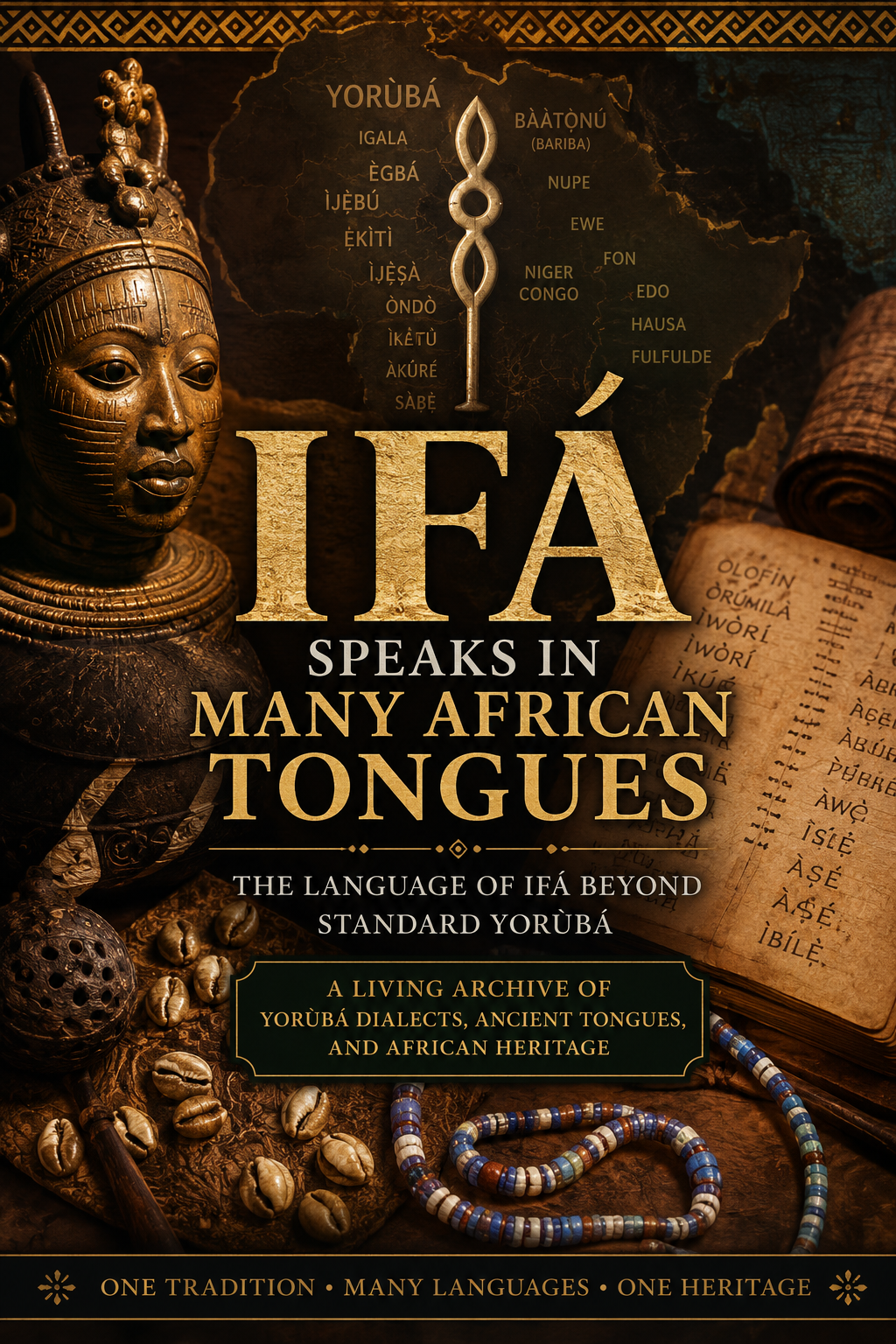
Ifá Speaks in Many African Tongues
Just yesterday, I came across a discussion where someone argued that sùúrù is not a Yorùbá word but one of Bààtɔ̀nú origin. My first reaction was not surprise. My question was: Do we really understand the language of Ifá?
Many people approach Ifá as though every word found in the Odù must originate from what is today called standard Yorùbá, largely based on the Ọ̀yọ́ variety of the language. That assumption overlooks both the nature of Ifá and the history of West Africa.
Ifá is an oral tradition that has been transmitted for centuries. During that time, it preserved not only spiritual wisdom but also layers of language that predate modern language standardization. The language of Ifá is therefore much broader than contemporary standard Yorùbá.
Ifá Speaks in Many Yorùbá Tongues
Standard Yorùbá is only one modern representation of a much older linguistic tradition.
Within Yorùbá itself exist numerous dialects and regional varieties, including:
Ifẹ̀
Ẹ̀gbá
Ìjẹ̀bú
Ìjẹ̀ṣà
Ẹ̀kìtì
Òǹdó
Àkúrẹ́
Ìlàjẹ
Kétu
Sàbẹ́
Àkókó Yorùbá
Ọ̀yọ́
Each preserves words, pronunciations, idioms, ritual expressions, and grammatical features that may no longer be common elsewhere.
When Babaláwo study the Odù, they regularly encounter expressions that sound unfamiliar to speakers of modern standard Ọ̀yọ́ Yorùbá. Yet those same expressions may still be recognized in Ifẹ̀, Kétu, Ìjẹ̀ṣà, Òǹdó, or other Yorùbá-speaking communities.
This demonstrates that Ifá preserves the linguistic diversity of the Yorùbá world rather than reflecting only one regional speech form.
The Language of Ifá Reflects a Wider West African World
The Yorùbá never lived in isolation.
For centuries they interacted with neighboring peoples, including the Bààtɔ̀nú, Nupe, Igala, Edo, Fon, Ewe, Hausa, and many others. Through trade, migration, diplomacy, warfare, and intermarriage, languages influenced one another.
It is therefore unsurprising that some words found in Yorùbá—and consequently in Ifá—may have entered through long periods of cultural contact. The discussion surrounding sùúrù is one example of this broader phenomenon.
Whether a particular word ultimately originated within Yorùbá or was borrowed generations ago does not diminish its place in the Ifá corpus. Once a word became part of the living language of those who transmitted Ifá, it became part of the tradition itself.
Ifá Preserves More Than Standard Yorùbá
Many verses preserve:
ancient Yorùbá vocabulary
regional Yorùbá dialects
ritual language
poetic constructions
obsolete expressions
specialized priestly terminology
historical loanwords that became integrated into Yorùbá
This is one reason experienced Babaláwo are often able to explain words that even fluent modern Yorùbá speakers no longer recognize.
The Odù are therefore not simply spiritual texts; they are also repositories of linguistic history.
A Living Linguistic Archive
When we study the language of Ifá, we should resist reducing it to the vocabulary of modern standard Ọ̀yọ́ Yorùbá.
Ifá preserves the voices of many Yorùbá communities across different regions and generations. It also reflects centuries of interaction between the Yorùbá and neighboring West African peoples.
The language of the Odù is therefore layered. Some words belong to ancient Yorùbá. Some survive only in regional dialects. Some bear the marks of historical contact with neighboring languages.
That richness is one of Ifá's greatest strengths.
To study Ifá is not only to study divination or philosophy. It is also to study the history of language, memory, and the interconnected civilizations of West Africa.